William Deighton Murder Stone
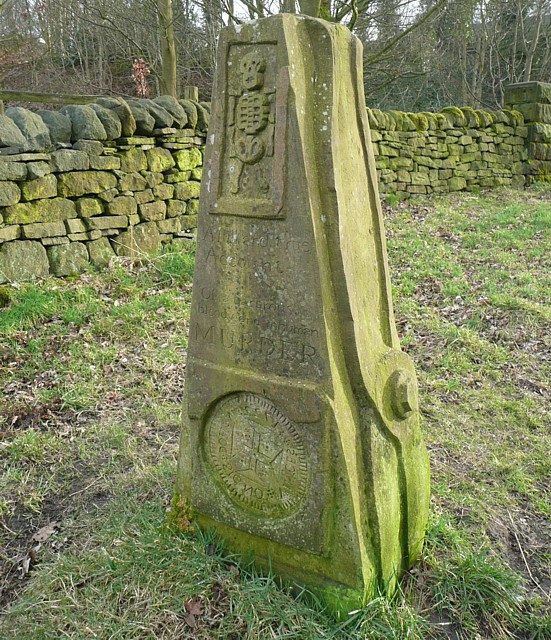
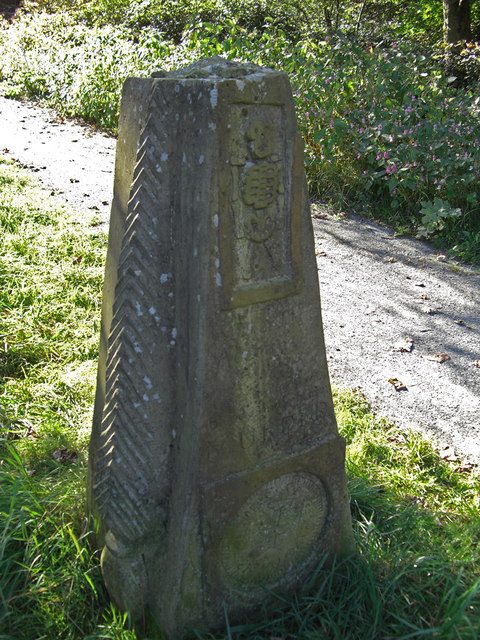
A full and true Account / Of a barbrous bloody and inhuman MURDER (below this, a carved depiction of the die used to strike a fake coin, dated 1722).Context & sources
Genuinely one of the most famous stories in Yorkshire criminal history, and a real oddity worth flagging: LOCATION MYSTERY - the murder happened in Halifax, and the criminal gang responsible were based in Cragg Vale, several miles away, yet this stone stands in neither place - it's at Brearley, on what's now National Cycle Route 66 / the Calder Valley Greenway. One local photographer who has passed it for years and researched it directly says nobody has been able to establish who erected it here or why. POSSIBLY MODERN, NOT PERIOD - a Geograph contributor notes it may be one of several sculpted stones commissioned by Sustrans to add interest along the National Cycle Network, which would make this a modern artistic tribute deliberately styled like an 18th-century murder broadside, rather than a genuine period monument - this is unconfirmed either way and would benefit from someone checking with Sustrans or Calderdale Council directly. THE STORY: William Deighton (also spelled Dighton), an excise officer sent to investigate the notorious 'Cragg Vale Coiners' - a large gang of counterfeiters who clipped and debased coins on an industrial scale, reportedly devaluing the pound by around 9% nationally - successfully turned one gang member into an informant and arrested the gang's leader, David 'King David' Hartley. Hartley's brother Isaac organised and crowdfunded a £100 bounty among fellow coiners to have Deighton killed. On the night of 10 November 1769, two hired men, Matthew Normanton and Robert Thomas, ambushed Deighton in Bull Close Lane, Halifax, and shot him in the head. The murder triggered a major crackdown: the Marquess of Rockingham (a former Prime Minister) personally led the manhunt, and around 30 coiners were arrested by Christmas Day 1769. David Hartley was hanged at York Tyburn (Knavesmire) on 28 April 1770 and is buried at Heptonstall. His brother Isaac, who organised the murder, was never caught and lived until 1815. Deighton's actual killers took years longer to bring to justice - accounts differ on the precise legal outcome: Wikipedia states both Thomas and Normanton were eventually hanged (1774 and 1775 respectively), while a Calderdale museum learning resource specifies Thomas was actually acquitted of the murder itself and was instead hanged later for a separate highway robbery. This story is the basis for Benjamin Myers's novel 'The Gallows Pole' and its 2023 BBC television adaptation directed by Shane Meadows. ARCHIVAL CHECK: The National Archives (Kew) catalogue holds two original State Papers Domestic items on this case - SP 37/7/44 (the Marquess of Rockingham's correspondence on hunting the killers and a Royal Bounty for Deighton's widow) and SP 37/8/57 (Joseph Broadbent's original informant statement). The catalogue description of SP 37/8/57 gives the shooting date as 9 November 1769, not the 10th used throughout this entry and every secondary source checked here - worth resolving from the document itself before treating either date as settled. Neither item is digitised for online reading (see sources_needing_visit). A contemporary report in the Leeds Intelligencer, 10 April 1770, is also cited by Wikipedia but sits behind the British Newspaper Archive paywall (see sources_needing_access). COORDINATES CORRECTED - thanks to D Smith for catching this and sending the correct location (13 Sep 2026): the previous coordinates (53.7230, -1.9350) were wrong, placing the pin about 2km from the actual site. Verified independently against a Geograph photo of this exact stone (matching inscription wording confirmed) by Humphrey Bolton, whose recorded camera/object location - 53d43m44sN, 1d57m50sW, i.e. 53.7289, -1.9639 - matches the submitted correction (53.729010, -1.965041) to within about 15 metres. Source: https://commons.wikimedia.org/wiki/File:Murder_Stone,Mytholmroyd-geograph.org.uk-_1200851.jpg
- MyLearning, Calderdale museums education resource
- Wikipedia, 'Cragg Vale Coiners'
- Halifax People, 'The Coiners of Cragg Vale'
- ExecutedToday.com
- Yorkshire Live / Examiner Live
- Colin Green Photography (on-the-ground account flagging the location mystery)
- Geograph Britain and Ireland (Sustrans theory)
- Wikimedia Commons / Geograph, photo by Humphrey Bolton, confirms exact location and inscription - https://commons.wikimedia.org/wiki/File:Murder_Stone,_Mytholmroyd_-_geograph.org.uk_-_1200851.jpg
Behind a paywall
- Leeds Intelligencer, news item on the coiners' arrests and trial, 10 April 1770, p.3 (quoted in part by Wikipedia's 'Cragg Vale Coiners' article) - full text behind British Newspaper Archive paywall.
Needs an in-person visit
- The National Archives, Kew - SP 37/7/44, Secretaries of State: State Papers Domestic, George III, letters incl. Marquess of Rockingham on the manhunt and the Royal Bounty for Deighton's widow (6 Oct 1767-1 Dec 1769).
- The National Archives, Kew - SP 37/8/57, copy of the information of Joseph Broadbent, weaver, concerning Deighton's murder (19 Sep-8 Oct 1771). Neither catalogued as digitised online - would need ordering/viewing at Kew.
- Town
- Brearley (near Mytholmroyd)
- County
- West Yorkshire
- Country
- England
- Coordinates
- 53.729010, -1.965041
- Year
- 1769
- Condition
- Legible
Know something we don't?
Submit a correction, an extra detail, or a photo for this record. Reviewed by hand before it's applied.