Tingwall Stone (Murder Stone)
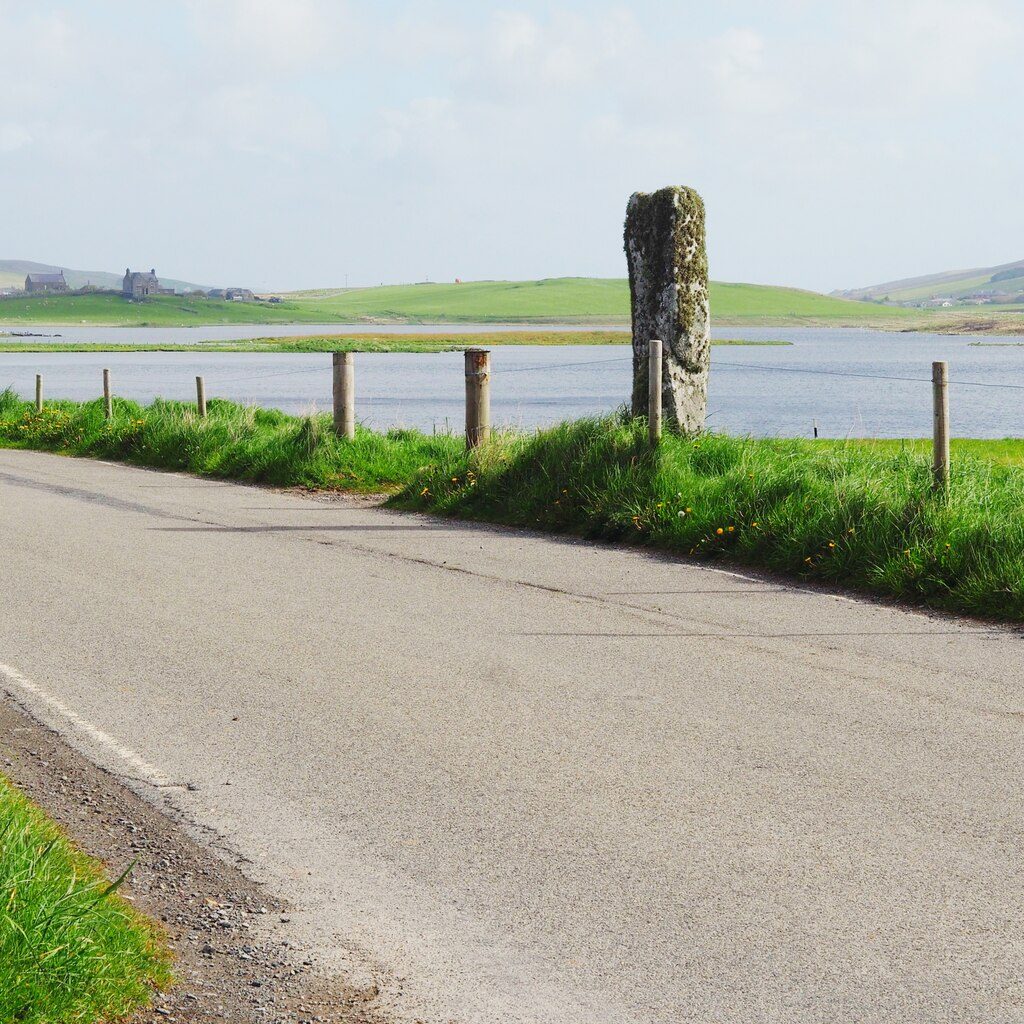
No carved inscription - a plain, unlettered granite standing stone (a menhir), about 2m tall and cracked/broken, standing between the Loch of Tingwall and the Loch of Asta, about 1.5km south of the ancient Law Ting Holm assembly site. Known locally as the Tingwall Stone, Mörderstein, or simply the Murder Stone.Context & sources
DOESN'T QUITE FIT THE SITE'S USUAL GENRE - LOGGED FOR TRANSPARENCY. Flagged via a wider sweep of geograph.org.uk's 'murder stones' tag, and worth including precisely because it's a good example of the boundary case: this is fundamentally a prehistoric standing stone (Historic Environment Scotland records it as an ancient monument, not a period murder memorial), not a stone raised to mark a specific killing the way every other 'genuine' entry in this archive is. Its 'Murder Stone' name has, however, become attached to a genuinely documented medieval killing: the Iceland Annals record that in 1389, 'Malise Sperra, with seven others, slain in Shetland by the Earl of Orkney' - and historians (via John R. Tudor's 1883 'The Orkney and Shetland: Their Past and Present State') have long associated this stone with that spot, in a power struggle between Henry Sinclair, 1st Earl of Orkney, and his cousin Malise Sperra, Lord of Skaldale. Beyond that, the sourcing gets genuinely tangled: (1) a folklore guidebook (Neil Fojut, 'A Guide to Prehistoric and Viking Shetland') records a 'probably recently invented' legend that murderers could win a pardon by outrunning the victim's family from the Law Ting Holm to this stone; (2) the diary of Rev. John Mill (parish minister of Dunrossness, Sandwick and Cunningsburgh), written in 1889, states the stone 'has been mentioned in the annals since 1329' - a full 60 years before the Sperra killing, which is hard to reconcile with the 1389 story being the origin of the name; (3) 'The New Statistical Account of Scotland' (1845) gives an entirely different tale - a son of the Earl of Orkney killed on his own father's orders on the Tingwall shore; and (4) at least one photographer's caption records a folk tradition that a captured Njugle (a Shetland water-horse) was once chained to the stone before breaking free. In short: a real, prehistoric monument that has accumulated several competing, only partly reconcilable stories of violent death over centuries, rather than a single documented murder memorialised on purpose. Treat as a folklore-and-archaeology curiosity rather than a 'murder stone' in the site's usual sense.
- German Wikipedia, 'Tingwall stone' (most detailed single write-up found, cites Tudor 1883, Rev. John Mill's 1889 diary, and the New Statistical Account 1845)
- Geograph, 'Standing stone between Lochs of Asta and Tingwall' by Mike Pennington (quotes Neil Fojut's guidebook)
- Geograph, 'Tingwall stone / Murder Stone' by Mick Garratt (gives the 1389/Malise Sperra tradition and the Njugle folklore)
- WikiTree, 'Malise Sperra (1355-1389)'
Behind a paywall
- Historic Environment Scotland / Trove (trove.scot, formerly Canmore) - the official national record for this stone; site blocks automated access with a bot-check, needs a person to search it directly.
- Neil Fojut, 'A Guide to Prehistoric and Viking Shetland' - only seen via a short quote on Geograph, not read in full.
- John R. Tudor, 'The Orkney and Shetland: Their Past and Present State' (1883) - quoted only in German translation on Wikipedia; the original English text not located here.
Needs an in-person visit
- Rev. John Mill's 1889 diary (as parish minister of Dunrossness, Sandwick and Cunningsburgh) - referenced via German Wikipedia only; original held in a Shetland archive, not located online.
- Town
- Tingwall / Scalloway
- County
- Shetland Islands
- Country
- Scotland
- Coordinates
- 60.1608, -1.2590
- Year
- 1389 (traditional; the stone itself is prehistoric)
- Condition
- Legible
Know something we don't?
Submit a correction, an extra detail, or a photo for this record. Reviewed by hand before it's applied.