The Written Stone
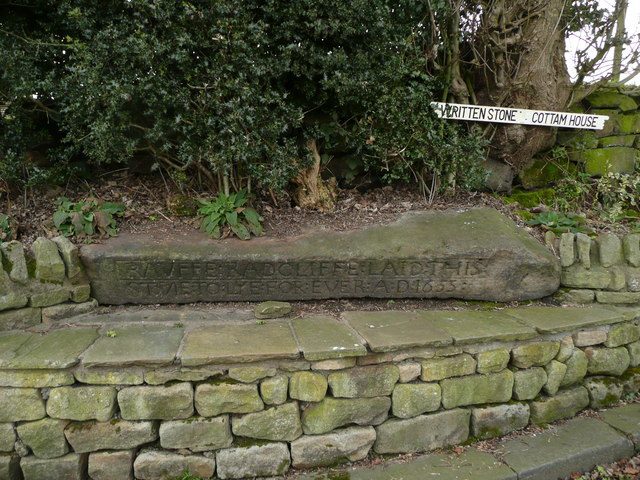
Official Historic England wording (list entry 1147440): 'RAVFFE RADCLIFFE LAID THIS STONE TO LYE FOR EVER AD 1655'. Tom C. Smith's 1888 transcription renders it near-identically: 'Ravffe Radcliffe laid this stone to lye for ever. A.D. 1655' (also seen as 'Rauffe'/'Rafe', period spellings of Ralph). Deeply incised, not raised, capital letters, on the side facing the road.Context & sources
UPDATED FROM A VISITOR SUBMISSION (Ben Simpson, 8 Sep 2026), then independently checked against Historic England's own listing and against the primary 19th-century source itself. Historic England (list entry 1147440, listed 22 Nov 1983) confirms the stone's dimensions (about 8ft long, 2ft wide, 18in deep, roughly 1.5 tonnes) and its exact grid reference, SD6261737902, in Longridge parish, Ribble Valley, Lancashire - Ben Simpson's figures for both matched the official listing exactly. It stands on Written Stone Lane (also called Boggart Lane), on an old Roman private road linking the forts at Ribchester and Lancaster, at the entrance to Written Stone Farm; the farmhouse is separately Grade II listed (1784, Bourn family), though the Radcliffe/Ratcliffe family were established there by the earlier 17th century. PRIMARY SOURCE READ DIRECTLY: Tom C. Smith's 'A History of Longridge and District' (1888), pp.27-30, read in full via Internet Archive rather than taken at second hand. Smith identifies Ralph (Ravffe/Rauffe/Rafe) Radcliffe as a large local property owner, 'probably a descendant' of Thomas de Radclyffe, a trustee named in John of Gaunt's will (d.1399), and states plainly that he cannot say why Radcliffe laid the stone, except to commemorate the death of some dear relative, or of himself. He then quotes the Ribchester parish registers' Longridge burials directly: Ralph Ratcliffe, died 26 Feb 1654; the son of the above Ralph, died 4 March 1654; William Radcliffe, died 20 May 1665 (CORRECTED HERE - the visitor submission this entry was updated from gave 26 May, but Smith's own footnote clearly reads 20 May); and the wife of John Radcliffe, died in May 1655 (the exact day illegible even to Smith). Smith's own conclusion: what is more likely than that this stone was laid either to commemorate these deaths following so close upon one another, or that a feeling of superstitious awe may have been awakened - certainly it is a curious coincidence, and not, he says, an undesigned one. DATE CONFUSION IN OTHER VICTORIAN SOURCES: Smith notes that two other 19th-century Lancashire historians - Baines, in his 'History of Lancashire', and Hardwick, in his 'History of Preston' - both transcribed the inscription's date wrongly; the scanned text is too degraded by OCR errors to be certain whether their wrong date reads as 1607 or 1007, but either way Smith is confident 1655 (matching the stone, and matching Historic England today) is correct. THE FOLKLORE, WITH ITS OWN SOURCE NAMED: tradition holds the spot was the site of a cruel and barbarous murder and that the stone was laid to appease the victim's restless spirit. Smith records the buttery-stone story himself - a later occupant of Written Stone Farm moved the slab into the farmhouse for use as a dairy surface, after which pots, pans and crockery were repeatedly thrown from it with a clattering noise all night until the stone was carried back to its original spot - and separately quotes, at length and by name, a writer in the Stonyhurst Magazine for the ghost stories proper: an unreachable female figure that paced ahead of a night traveller without ever being caught, and a local doctor whose horse supposedly bolted a mile or two in terror after passing the stone, returning covered in blood, and who was later seized by a shapeless mass after drunkenly wagering he would ride back to it at night. SMITH DEBUNKS HIS OWN SOURCE: in a footnote, Smith measures the lane itself to undercut the horse story - the distance from the stone to the gate at one end is only about 30 yards, and to the other end only 200 yards, nowhere near enough room for a horse to have galloped a mile or two as the Stonyhurst Magazine account claimed. Writing in 1888, Smith notes the stone was already an object of pilgrimage for locals and hoped it would never be moved from its site. Some writers (unconfirmed, speculative) have suggested the slab predates 1655 entirely - a reused standing stone, altar, or lintel that Radcliffe simply had re-laid and re-carved - but this remains unproven. In short: the solid 17th-century fact is an inscribed memorial or boundary stone laid by Ralph Radcliffe in 1655, plausibly connected to a real cluster of family deaths recorded in the parish register; the murder itself has no primary evidence behind it anywhere and reads as 19th-century folklore layered onto an already-existing stone. FURTHER UPDATE (Sep 2026): Ben Simpson sent over a Word document consolidating his research plus five photographs - mostly a tidy restatement of his original submission (nothing here contradicted what's already above), but one photo turned up a genuine new lead. An old glass-slide photo of the stone is captioned 'THE LAYING STONE, KNOWL GREEN, PHOTO BY F. BUCK, CLITHEROE'. That photo is catalogued in Lancashire County Council's Red Rose Collections archive (iBase ID 269748, reference ECL20140225013) as 'The Laying Stone, Knowl Green (sic)' - the '(sic)' is the council's own, correcting 'Knowl Green' to the real place name 'Knowle Green', a hamlet near Longridge. The archive record names the photographer as Edmundson Buck (1859-1941) and describes the item as a monochrome glass lantern slide. Crucially, the archive record's own bibliography resolves a citation this entry previously couldn't pin down: it names the '1873 Lancashire Legends account' precisely as John Harland and T.T. Wilkinson, 'Lancashire Legends, Traditions, Pageants, Sports, &c.' (1873), alongside a second source, Jessica Lofthouse's 'Lancashire's Fair Face' (1952). The 1873 book was read directly here (Internet Archive), and it turns out to be Smith's own source - his 1888 account closely paraphrases it, including the buttery-stone story and the closing 'Rest, perturbed spirit' Hamlet line almost word for word. The 1873 account is itself secondhand: it's built entirely around a visit described by 'the anonymous author of "The New Clock"', in his book 'Curious Corners round Preston' - a source not identified or read here, but the earliest link in the chain found so far (New Clock's author -> Harland & Wilkinson 1873 -> Smith 1888 -> every modern retelling since). Two genuine discrepancies emerge from reading 1873 directly rather than at second hand: (1) the stone's dimensions are given there as nine feet long and a foot thick, placed 'like a gravestone on the cop' [top of a bank/wall] - measurably different from Historic England's 8 feet/18 inches, though both figures have been repeated consistently within their own source traditions ever since; (2) the wrong-date rival version is confirmed precisely here rather than left ambiguous - Harland and Wilkinson quote Baines's 'History of Lancashire' (vol. iii, p.383) as giving the inscription as 'Rafe Ratcliffe laid this stone here to lie for ever. A.D. 1607', and state plainly themselves that 'neither christian name nor surname nor date agrees with the text, which latter, however, we believe to be correct' - i.e., Baines's 1607/Rafe Ratcliffe version was already known to be wrong in 1873, over a decade before Smith repeated the same correction. The other new photo Ben Simpson sent (a modern colour shot) shows the roadside signpost reading 'WRITTEN STONE FARM' / 'COTTAM HOUSE FARM' side by side, corroborating the farm's earlier association with Cottam House already noted above.
- Historic England, list entry 1147440, 'The Written Stone, Longridge' - https://historicengland.org.uk/listing/the-list/list-entry/1147440
- Tom C. Smith, 'A History of Longridge and District' (1888), pp.27-30, full text - https://archive.org/details/historyoflongrid00smit (also readable directly as OCR text at https://archive.org/stream/historyoflongrid00smit/historyoflongrid00smit_djvu.txt)
- Geograph, 'The Written Stone' by Peter Worrell - https://www.geograph.org.uk/photo/707675
- visitor submission from Ben Simpson, 8 Sep 2026, first identified the Historic England listing number and the Smith citation this entry was then checked against directly
- John Harland and T.T. Wilkinson, Lancashire Legends, Traditions, Pageants, Sports, and c. (1873), The Written Stone in Dilworth, pp.13-15, read in full - https://archive.org/stream/lancashirelegen00harlgoog/lancashirelegen00harlgoog_djvu.txt
- Lancashire County Council, Red Rose Collections, The Laying Stone, Knowl Green (sic) (photograph by Edmundson Buck, 1859-1941; names both the Harland and Wilkinson and Lofthouse sources) - https://redrosecollections.lancashire.gov.uk (search Laying Stone, iBase ID 269748)
Behind a paywall
- The New Clock (pseudonymous or otherwise unidentified author), Curious Corners round Preston - the earliest source found in the chain behind this stones folklore, quoted at length by Harland and Wilkinson (1873) but not itself located or read here. Jessica Lofthouse, Lancashires Fair Face (1952) - named by Lancashire County Councils own archive record as a source, not read here. The original Ribchester parish registers themselves - Smiths transcription has at least one illegible entry, the day of the wife of John Radcliffes death in May 1655.
Needs an in-person visit
- Lancashire Archives - any original source for the 'restless spirit' legend and its connection (if any) to a real killing has not been traced beyond local oral tradition.
- Town
- Knowle Green, Longridge
- County
- Lancashire
- Country
- England
- Coordinates
- 53.8364, -2.5695
- Year
- 1655 (stone dated); murder undocumented
- Condition
- Legible
Know something we don't?
Submit a correction, an extra detail, or a photo for this record. Reviewed by hand before it's applied.