The Sailor's Stone
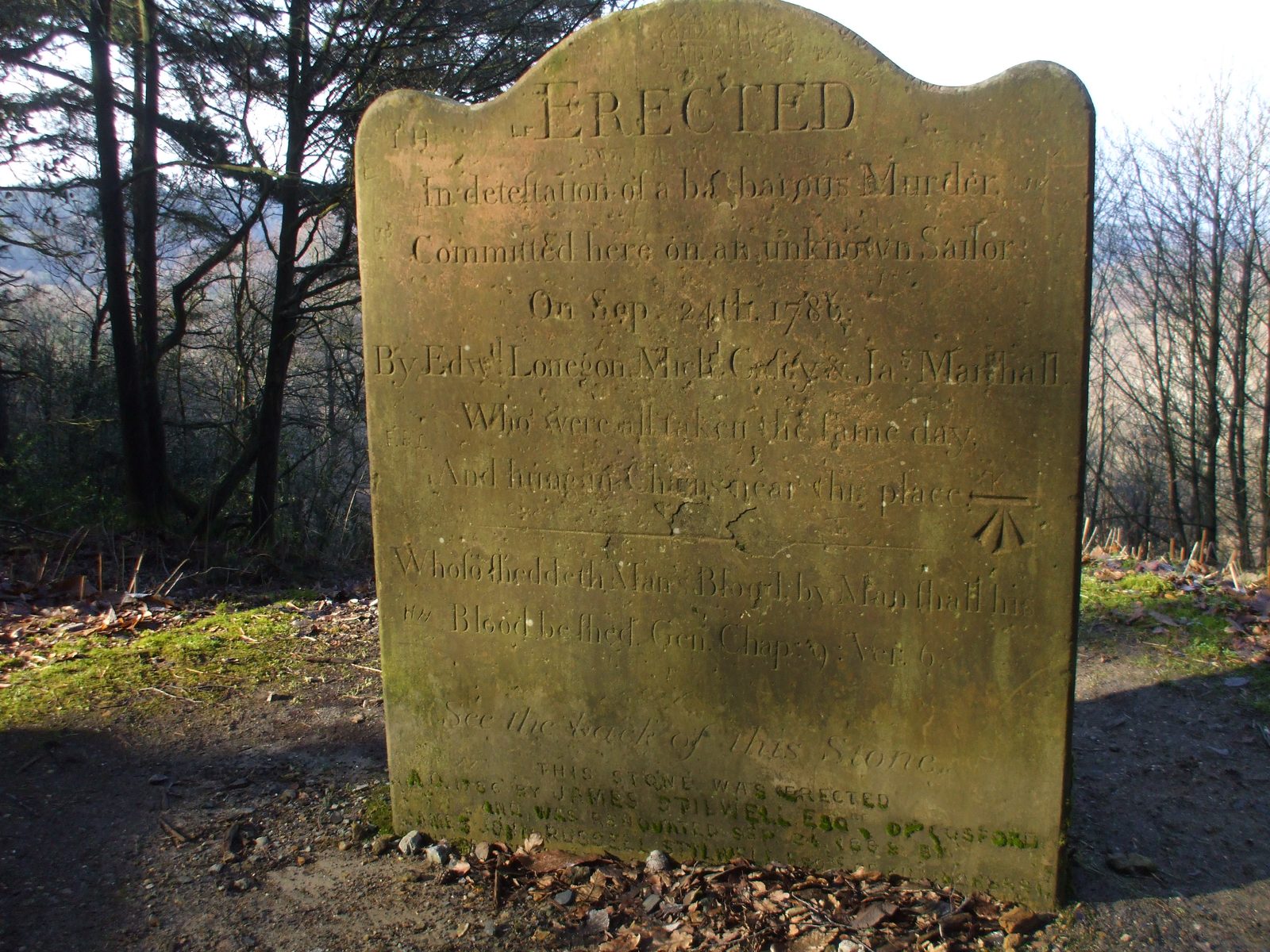
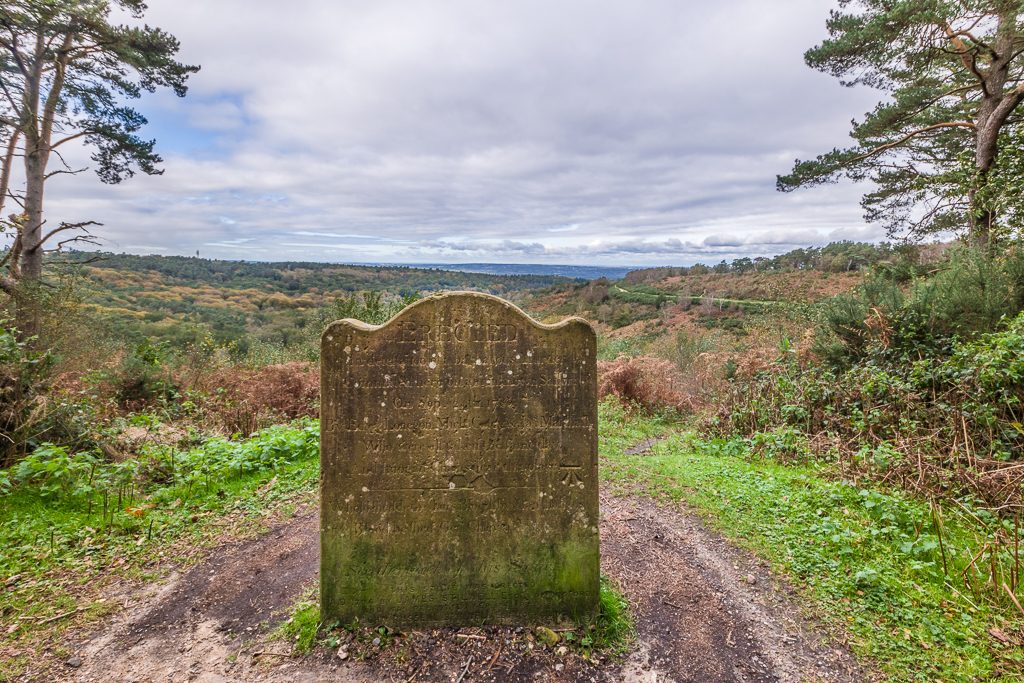
CORRECTION: three separate monuments exist for this case and were previously conflated - see context for all three inscriptions kept properly distinct. THE MURDER-SITE STONE ('The Sailor's Stone', Old Portsmouth Road/the Punchbowl) reads, so far as recovered: 'ERECTED In detestation of a barbarous Murder Committed here on an unknown Sailor On Sep. 24th 1786 By Edw[ard Lonegon, and accomplices]...' - the full list of names is cut off in the source found and needs completing from a direct visit or a fuller transcription.Context & sources
THREE SEPARATE MONUMENTS EXIST for this case, previously run together in this entry - now corrected and kept distinct, following the same pattern as the James Stares two-monument case. (1) THE SAILOR'S STONE ITSELF, at the actual murder site on the Old Portsmouth Road in the Punchbowl, erected soon after the killing by James Stillwell of nearby Cosford Mill - inscription above, only partially recovered. (2) HIS GRAVE, in Thursley churchyard, Grade II listed, paid for by public subscription among the villagers, reading in full: 'In memory of A generous but unfortunate Sailor Who was barbarously murder'd on Hindhead On September 24th 1786 By three Villains After he had liberally treated them And promised them his farther assistance On the road to Portsmouth.' (3) THE EXECUTION SITE ON GIBBET HILL - not marked by anything contemporary; instead, 65 years later in 1851, lawyer and judge Sir William Erle paid for an imposing granite Celtic cross to be erected on the site of the scaffold itself, specifically to dispel lingering local fears and superstitions about the spot. It carries four Latin phrases around its base: 'POST TENEBRAS LUX. IN OBITU PAX. IN LUCE SPES. POST OBITUM SALUS' - 'Light after darkness. Peace in passing away. Hope in light. Salvation after death.' THE STORY: an unidentified sailor, possibly named Edward Hardman per a 2000 book by local historian Peter Moorey (unconfirmed), stopped at the Red Lion Inn in Thursley on his way from London to rejoin his ship at Portsmouth. There he generously bought food and drink for three fellow seafarers he'd just met - James Marshall, Michael Casey, and Edward Lonegon - who then followed him onto Hindhead Hill, robbed him, and killed him, nearly severing his head. They were caught within days trying to sell his clothes at the Sun Inn in Rake. All three were tried at Kingston Assizes and hanged in chains on a triple gibbet on 7 April 1787, close to the murder scene - reportedly the only gibbet in the country at the time built to hold three bodies at once. Their tarred remains were left hanging for years as a warning; the naturalist Gilbert White of Selborne recorded in his own journal on 23 December 1790 that a storm had knocked one of the bodies to the ground. BONUS DETAIL: the blacksmith who forged the gibbet irons and chains, Richard Court, is also buried in Thursley churchyard with his own inscribed headstone, though its text wasn't recovered here. Charles Dickens has Nicholas Nickleby read the murder-site stone's inscription aloud in 'Nicholas Nickleby' (1839); Bram Stoker also wrote a short story called 'Gibbet Hill' inspired by the tale in 1890. FULL INSCRIPTION RECOVERED: the Thursley History Society, drawing on a Parish Magazine article by Jackie Rickenberg (Oct 2021), gives the complete text of the murder-site stone, where the list of names was cut off above: 'ERECTED In detestation of a barbarous Murder Committed here on an unknown Sailor On Sep. 24th 1786 By Edwd. Lonegon, Mich. Casey & Jas. Marshall Who were all taken the same day And hung in Chains near this place Whoso sheddeth Man's Blood by Man shall his Blood be shed: Genesis Chap 9 Ver 6' - worth transferring into the inscription field above. The same page also supplies the previously-unrecovered inscription on blacksmith Richard Court's headstone: 'My Sledge and Hammer lie reclin'd, My Bellows too have lost their wind; My Fire is out, and Forge decay's, And in the Dust my Vice is laid.' It also quotes in full a genuine contemporary source - the Hampshire Chronicle, 2 October 1786 - describing the murder and the men's capture within hours at the Sun Inn, Rake. The society's site additionally hosts full downloadable PDFs of Peter Moorey's 2000 book 'Who Was The Sailor Murdered At Hindhead' and a contemporary extract from The Daily Universal Register, 4 October 1786 - both identified but not fully read here (see sources_needing_access). STARTING POINT IDENTIFIED: Historic England's listing for the White Lion PH, Milford (Surrey) identifies it as the inn where the sailor first met the three men and treated them to a drink, before they all walked on together to the Red Lion at Thursley for further drinks at his expense - filling in the very start of the fatal encounter, upstream of the Red Lion detail already given above.
- Wikipedia, 'Unknown Sailor'
- Wikipedia, 'Gibbet Hill, Hindhead'
- Thursley History Society (most detailed single source, including the murder-site stone's actual inscription)
- Atlas Obscura
- Surrey Hills National Landscape
- St George's Church, Surrey local history page
- Wikishire, 'Gibbet Hill, Surrey'
- Grokipedia (cites Gilbert White's journal directly)
- Thursley History Society, 'The Murder of the Unknown Sailor, aka The Hindhead Murder' by Jackie Rickenberg (Parish Magazine, Oct 2021)
- Historic England, list entry 1439741, 'The White Lion PH, Milford'
Behind a paywall
- Peter Moorey, 'Who Was The Sailor Murdered At Hindhead' (2000) - full book PDF hosted by Thursley History Society (linked from their site, exact file URL not captured here).
- The Daily Universal Register, 4 October 1786 - PDF extract hosted by the same society, not yet read in full.
- Town
- Thursley
- County
- Surrey
- Country
- England
- Coordinates
- 51.1252, -0.7275
- Year
- 1786
- Condition
- Legible
Know something we don't?
Submit a correction, an extra detail, or a photo for this record. Reviewed by hand before it's applied.